

EVIDENCE
AHDÜM’s evidence layer connects Gaza teaching-continuity practice, P4ES / Crisis-Infostructure proof-of-concept work, QS Reimagine Education 2025 recognition, QS Innovations Directory listing, and selected academic foundations that inform CRUI’s readiness logic.
Scale logic
CRUI READINESS REVIEW EVIDENCE
METHOD REFINEMENT
REPLICATION & EVIDENCE SUFFICIENCY
INSTITUTIONAL ALIGNMENT
FOUNDING PROOF
FUTURE GOVERNED PATHWAYS
Trust layer
E.01
Documented teaching-continuity practice in Gaza (2023–2025), including a coordinated network of more than 150 volunteer educators supporting Gaza University under severe disruption and weak connectivity. Within that wider effort, Hussein AlAhmad developed and introduced the Crisis-Infostructure Model as a pedagogical continuity approach. The figure is programme-level context and not a CRUI-specific intervention.
Documentary evidence: Official letter from Gaza University confirming the teaching-continuity contribution and application of the Crisis-Infostructure Model. View evidence →
E.02
A mixed-methods learning-continuity intervention conducted across five universities under war, displacement, infrastructure collapse, and severe mobility and communication constraints. Participant scope was determined by safety, ethical, and access conditions. The study linked evidence, communication, access, materials flow, and coordination under disruption.
Peer-reviewed evidence: “Reclaiming narrative sovereignty: education as counter-narrative in Occupied Palestine,” Third World Quarterly (2026). View study →
E.03
Global Shortlist — Neuroscience of Learning
Bronze Winner — Regional Award: Middle East
These recognitions relate to P4ES — Pedagogies for Epistemic Sovereignty — and document the field-tested educational work that informed AHDÜM’s later institutional development and CRUI’s readiness logic.
E.04
Public listing supporting the visibility of the P4ES innovation pathway.
E.05
AHDÜM Education Resilience Metrics received a QS Certificate of Recognition in appreciation of its submission to the 2026 Reimagine Education Awards, acknowledging the creativity, commitment and dedication to advancing teaching and learning reflected in the submission.
Certificate of Recognition for the 2026 submission; not a shortlist or award. View Certificate →
E.06
Selected publications and conceptual models:
Reclaiming narrative sovereignty: education as counter-narrative in Occupied Palestine; Third World Quarterly (2026). View article →
Out of time for the version of record: designing living knowledge infrastructure for AI-accelerated scholarship; AI & Society (2026). View article →
The Mediatization of Education: Classroom Mediation as an Agent of Change in Middle Eastern Higher Education Systems; Palgrave Macmillan, Cham (2023). View chapter →
The Role of Educational Communication in Promoting a Student-Centered Learning Style in Multicultural Classrooms; International Journal of Research in Education and Science (2021). Review article →
SELECTED INTERNATIONAL CONFERENCES
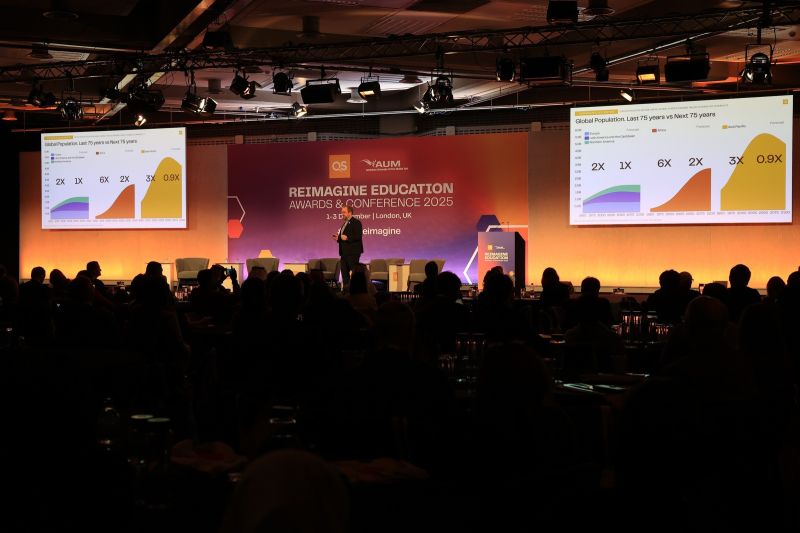
QS Reimagine Education Conference & Awards, QEII Centre, London, UK – project showcase: Pedagogies for Epistemic Sovereignty. “Neuroscience of Learning track, Bronze Regional Winner” (Dec 1–3, 2025),
Research in Crisis Settings Conference 2025: American University of Beirut (AUB), Beirut, Lebanon; Oral presentation: ‘Crisis-Responsive Mediatized Pedagogy in Palestine’ (Sep 23–26, 2025),
Aurora International Peace Conference: Paper: ‘The Mediatization of Education as a Catalyst for Peacebuilding in the Middle East: The Case of Palestinian Split. University of Innsbruck (Feb 17–21, 2025).
RECOGNITION EVIDENCE
QS Reimagine Education 2025,
Bronze Winner, Regional Award: Middle East
P4ES — Pedagogies for Epistemic Sovereignty, a learning-continuity and educational recovery initiative developed during the October 2023 war in Gaza, was named Bronze Winner — Regional Award: Middle East at QS Reimagine Education 2025. This recognition documents the field-tested work that informed AHDÜM’s subsequent institutional development and CRUI’s readiness logic.

Validated CRUI findings may inform separately scoped Field Learning Continuity support where material access or minimum-continuity gaps require action. Any such support is optional, supplier-neutral, and governed through a distinct agreement, technical and safety validation, and institution-controlled procurement. CRUI findings are finalised independently before implementation support is considered, and acceptance, rejection, or supplier choice has no effect on findings, scoring, or future review status.
EXPLORE THE CRUI READINESS REVIEW
→
Development Alignment
AHDÜM supports SDG-aligned institutional documentation by helping universities organise evidence around learning continuity, access, resilient infrastructure, governance readiness, and partnership-based improvement. This alignment supports reporting and institutional reflection within existing quality and sustainability processes.
SDG 4
Quality Education
Learning continuity, inclusive access, and evidence-based improvement.
SDG 9
Industry, Innovation and Infrastructure
Resilient digital/connectivity systems and institutional continuity infrastructure.
SDG 11
Sustainable Cities and Communities
University resilience as part of wider preparedness and recovery capacity.
SDG 13
Climate Action
Continuity planning for climate-related and infrastructure disruption.
SDG 16
Peace, Justice and Strong Institutions
Trusted governance, documentation, coordination, and institutional accountability.
SDG 17
University, council, ministry, and partner collaboration for resilience.
This alignment supports institutional documentation, reporting, and reflection within existing quality and sustainability processes.
ACADEMIC AND SCIENTIFIC FOUNDATIONS
AHDÜM is grounded in selected scholarly and applied work on mediatized education, strategic communication, crisis-responsive learning, knowledge integrity, and institutional resilience. Selected evidence anchors include publications, conceptual and applied models, documented innovation evidence, registered or licensed materials where documentation exists, and international conference contributions.
ORCID: 0000-0001-5347-9965
Web of Science ResearcherID: KFW-4201-2024
The evidence layer supports trust. The review pathway turns it into action.